Murmansk is the capital of the Arctic
The city of Murmansk is the administrative center of the Murmansk region
Founded on October 4, 1916.
Initially, the city was proclaimed as "Romanov-on-Murman", and only in April 1917 was it given its current name "Murmansk".
Along with its administrative functions as the recognized capital of the Russian Arctic, Murmansk occupies a leading position in the region's economy, serving as its financial, business, demographic, and cultural center.
The city is located above the Arctic Circle, among endless hills on the shores of the ice-free Kola Bay, 56 kilometers from the mouth of the Barents Sea. Its geographic coordinates are 68°58' north latitude and 33°03' east longitude.
The city's total area is 154.4 square kilometers, including a 13.5-square-kilometer section of the Kola Bay and a coastline of over 10,000 meters.
Murmansk is the largest city in the world north of the Arctic Circle, with a population of approximately 300,000.
The city is located in the Moscow Time Zone (MSK). The offset from UTC is +3:00 (MSK).
Murmansk is located 1967 km north of Moscow and 1448 km from St. Petersburg.
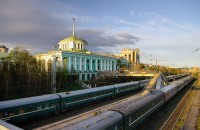
Murmansk can be reached by plane, train, or car. Murmansk Airport handles flights not only within Russia but also internationally. Direct rail connections from Murmansk are available daily to Moscow, St. Petersburg, Vologda, Minsk, and many other cities, and in the summer, trains also connect you to southern cities like Anapa and Adler. Murmansk is located on the Kola federal highway (M18), which provides access to any corner of the region, including St. Petersburg and Moscow. Murmansk is also the starting point for the A138 highway to Norway and the P12 highway to Finland.
During various years of prosperity, Murmansk was awarded the highest state awards.
The Order of the Red Banner of Labor was awarded in 1971 for the achievements "achieved by the city's workers in fulfilling the tasks of developing industrial production."
The Order of the Patriotic War, 1st Class, was awarded in 1982 for the courage and fortitude demonstrated by the city's residents in the fight against the German invaders and for the successes achieved in economic and cultural development during the Great Patriotic War.
1985 - For outstanding services during the Great Patriotic War, Murmansk was awarded the title of "Hero City" and the Order of Lenin and the Gold Star Medal.
Murmansk's climate ranks it among the Far North. However, thanks to the warm Gulf Stream, Murmansk is significantly warmer than the central Kola Peninsula.
Every year, from December 2nd to January 11th, polar night sets in at Murmansk's latitude for 40 days. On the first day after the polar night, the sun rises over the city for only 19 minutes.
In winter, you can observe the Northern Lights—a stunningly beautiful natural phenomenon. That's why the Northern Lights are depicted on the city's coat of arms.
In summer, Murmansk experiences the polar day, which lasts 62 calendar days. For two months starting on May 20th, the sun doesn't set, and starting on July 24th, the sun barely touches the horizon for about a week before rising again. Throughout this period—until mid-August—nights in Murmansk are bright every year. This is why Murmansk is known as the city of white nights.
Murmansk's weather is unlike most cities located above the Arctic Circle: it's unusually frequent and subject to sharp daily changes. A brief thaw in winter or heavy snowfall in summer are common. This is why discussions about the weather are so popular among Murmansk residents.
The official symbol of the city is its coat of arms
 The city's coat of arms is a rectangular heraldic shield with a base-to-height ratio of eight to nine, rounded lower corners, and a pointed tip. It corresponds to the following heraldic description: in an azure field at the top is a waving truncated pennant, repeatedly divided with gold and matching the field's color; at the bottom is a transport vessel (without sails); in the gold tip is an azure fish with golden eyes and gills.
The adopted colors on the shield's field represent: azure and gold in the upper part represent the polar night and polar day, and the gold color of the lower part represents the wealth of the seas in which Murmansk fishermen fish.
The silhouette of a fish symbolizes the city's main industry—fishing; the golden eyes and gills of the fish represent the power of nature; and the silhouette of a transport vessel symbolizes the city of Murmansk as a major seaport.
The fluttering truncated pennant symbolizes the aurora borealis and emphasizes Murmansk's geographical location within the Arctic Circle.
Murmansk – Russia's Arctic outpost
Murmansk is the center of the Barents Region's fishing industry, boasting unique biological resources. Historically, it is Russia's most important ice-free port, the center of the Russian icebreaker fleet, and the home of the world's first icebreaker and the world's largest sailing ship. And only in Murmansk can one fully observe unique northern phenomena: polar nights and days, the aurora borealis, low trees, and northern berries. This is why many tourists are struck by Murmansk's combination of the seemingly incompatible: harsh northern conditions, fortitude and warmth of spirit, and natural beauty.
City mission
Murmansk residents cherish the achievements of the past and confidently look to the future. Together, they strive to make life in Murmansk better, more interesting, and more comfortable.
Every Murmansk resident strives to ensure that our city attracts more and more people from all corners of the country and abroad, both near and far. And that everyone who visits Murmansk will want to stay or will return for new experiences.
Therefore, the mission of the city of Murmansk is: "Murmansk – a city with a high quality of life, a comfortable urban environment, a Russian center for Arctic development, with development priorities in the areas of fisheries and transportation."
Murmansk is always a joy to meet up with both old and new friends!!!
And the weather isn't always kind to us, because not everyone likes it hot!
Once you've visited Murmansk, trust us, you'll definitely
come back again and again!!!